Workplace Stress and Burnout in 2026: What Gallup and Deloitte's Data Reveals
A data-led look at what Gallup and Deloitte's latest research actually shows about workplace stress, burnout, and the pressures AI adoption is adding to an already stretched workforce.
By Mwiza Nyirenda, Head of Data Analytics, Titan Wellness ·
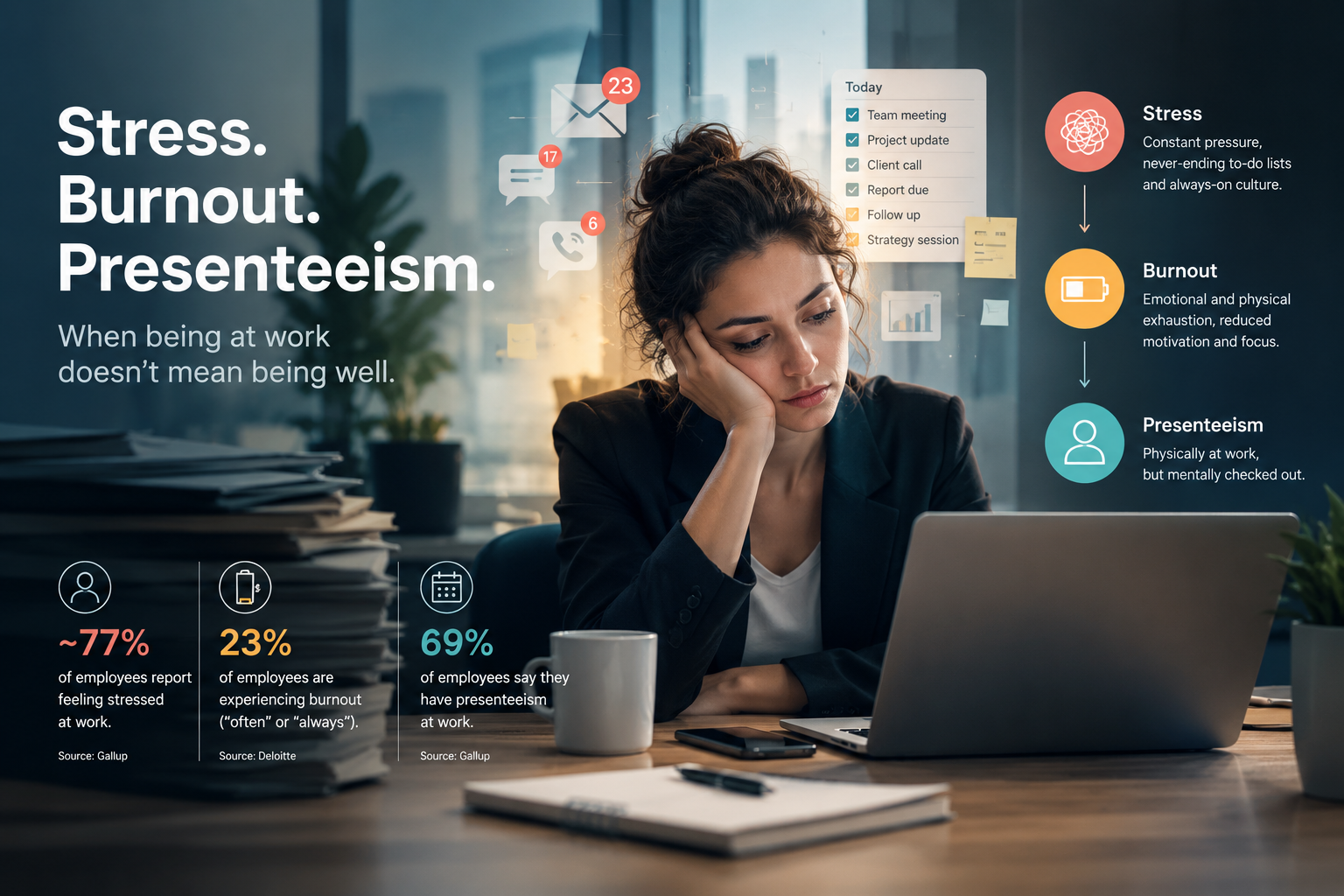
Despite years of corporate wellbeing investment, workplace stress and burnout remain stubbornly high heading into 2026. And new pressures are layering onto an already strained baseline — chief among them, the pace of AI adoption across organisations. This piece sets aside anecdote and looks directly at what the latest research actually shows.
What Gallup's 2026 data shows
Gallup's State of the Global Workplace 2026 report paints a sobering picture. Global employee engagement fell to 20% in 2025 — its lowest point since 2020, and down from a 2023 peak of 23%. Gallup estimates this disengagement costs the world economy roughly $10 trillion in lost productivity, close to 9% of global GDP.
The decline isn't evenly spread. Manager engagement has fallen 9 percentage points since 2022, from 31% down to 22%, while non-manager engagement has held closer to 19%. Managers, in other words, have lost engagement faster than the people they lead. Daily stress also remains elevated compared with pre-pandemic levels: Gallup finds 40% of employees report experiencing significant daily stress, and leaders report stress at rates 7 points higher than individual contributors.
The AI factor
Gallup's 2026 research also looked specifically at AI adoption in the workplace, and the finding is telling. Among US workers at companies actively implementing AI, 65% report personal productivity gains from it. But only 12% strongly agree that AI has meaningfully transformed how their organisation actually works. That's a wide gap between individual-level benefit and organisation-level change.
It would be easy to read this as "AI is causing burnout" — but that's not what Gallup's own framing says. The research links burnout to poor change management and unclear implementation, not to AI adoption itself. In practice, that means the stress shows up when a tool is introduced without a clear plan for how work is meant to change around it, not because the tool exists. It's a nuanced point, and an important one for employers to get right before reaching for an "AI wellbeing" fix.
Looking at support for your teams? Explore our corporate wellbeing services
What Deloitte's Well-Being at Work survey found
Deloitte's Well-Being at Work survey adds further detail. 52% of workers say they always or often feel exhausted, 49% frequently feel stressed, 43% feel overwhelmed, and 40% say their job negatively affects their mental wellbeing. These aren't marginal figures — they describe a majority or near-majority experience.
Deloitte also identifies a striking perception gap. A large majority of executives believe workforce wellbeing has improved, yet only 63% of employees rate their own physical wellbeing as good or excellent. That disconnect matters for retention: 60% of employees, 64% of managers, and as many as 75% of C-suite executives say they have seriously considered leaving a role because of inadequate wellbeing support. And when asked what actually stands in the way, 80% of employees point to heavy workload and long hours as their primary obstacle to wellbeing.
The business case for acting
The financial case is measurable too. The UK Health and Safety Executive estimates that work-related ill health costs UK businesses roughly £4.1bn a year, with stress, depression and anxiety the single largest cause at 51% — ahead of musculoskeletal disorders at 27%. And presenteeism carries its own quantifiable cost: research by Burton et al. (2005) found a 2.4% drop in productivity for each additional health risk factor an employee carries, adding up to an estimated £2,145 in annual productivity cost per person.
What this means for employer wellbeing programmes
Taken together, this data makes one thing clear: stress and burnout are systemic and data-verifiable, not anecdotal. They show up consistently across Gallup's global engagement figures, Deloitte's workforce surveys, and the UK's own occupational health statistics.
AI adoption is best understood as one more pressure layered onto an already-stretched workforce, not a new category of problem requiring its own bolt-on initiative. Given how sharply manager engagement and manager stress in particular have moved, the more useful response is better change management and stronger manager support around how new tools and ways of working are introduced — not a standalone "AI wellbeing" programme.
More broadly, a fragmented, one-off approach to wellbeing simply doesn't match the scale of the problem this data shows. What it argues for is structured, ongoing support — built into how an organisation operates day to day, rather than bolted on as a single event or perk.
This is exactly the gap Titan Wellness's employee wellbeing programmes are built to close — combining fitness, nutrition, mental health support and related services into a sustained, structured offering rather than a one-off intervention. If the data above reflects pressures you're seeing in your own organisation, get in touch to book a consultation.
Frequently asked questions
What does Gallup's State of the Global Workplace report say about employee engagement?
Gallup's State of the Global Workplace 2026 report finds global employee engagement fell to 20% in 2025, its lowest point since 2020, down from a 2023 peak of 23%. Gallup estimates this disengagement costs the world economy roughly $10 trillion in lost productivity, close to 9% of global GDP. Gallup also finds 40% of employees report experiencing significant daily stress.
What does Deloitte's Well-Being at Work survey reveal about stress and burnout?
Deloitte's Well-Being at Work survey finds 52% of workers say they always or often feel exhausted, 49% frequently feel stressed, 43% feel overwhelmed, and 40% say their job negatively affects their mental wellbeing. Deloitte also finds only 63% of employees rate their own physical wellbeing as good or excellent, and 80% point to heavy workload and long hours as their primary obstacle to wellbeing.
Why is AI adoption described as adding a new kind of stress in the workplace?
Gallup's 2026 research finds that among US workers at companies actively implementing AI, 65% report personal productivity gains, yet only 12% strongly agree AI has meaningfully transformed how their organisation actually works. Gallup links burnout in this context to poor change management and unclear implementation rather than to AI adoption itself, with manager engagement having fallen 9 percentage points since 2022.
What can employers do to address workplace stress and burnout, based on this data?
Given how sharply manager engagement and manager stress have moved, the more useful response is better change management and stronger manager support around how new tools and ways of working are introduced, rather than a standalone AI wellbeing programme. The recommended approach is structured, ongoing support built into daily operations rather than a one-off event or perk.
Ready to build a wellbeing programme that matches the scale of the problem?
Get in touch with our team at sales@titanwellness.ie to book a consultation or request a proposal.